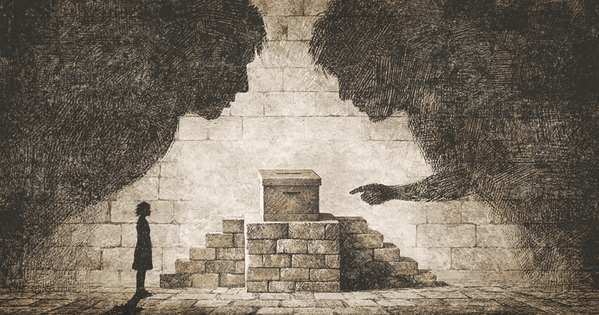
The Duverger Syndrome is democracies' most critical illness. Both the causes and the fixes are known. Solutions must be applied as a matter of priority.
The Good Candidate Drought — Symptom 3 of the Duverger Syndrome — operates before the voter acts, filtering the field at the stage of recruitment, primary selection, and funding survival. By general election day, that work is done. What the voter faces is not a choice between two visions for the country. It is a choice between two sources of anxiety.
The lesser of two evils is the voter's name for this experience. It is heard in every country that uses single-choice voting, expressed with the same mixture of resignation and resentment: "I'm not voting for anyone. I'm voting against someone I hate more." This sentence — widely spoken, rarely named — describes a democratic transaction that has lost its essential meaning. The ballot has become an instrument of fear management, not positive aspiration.
A voter choosing the lesser evil is not expressing a democratic preference. They are making a calculation about harm reduction — which failure mode is more survivable, which set of bad policies is more reversible, which candidate is less likely to do the thing they most fear. The candidate who wins this calculation has not been chosen. They have been less rejected.
In a functioning democratic system, the voter's job is to select the candidate who best represents their interests, values, and judgment about the future. The lesser-evil voter cannot do this job. The candidate they would choose has already been eliminated — by the primary, by the donor network, by the media test, or by their own decision not to run. What remains are two candidates, neither genuinely wanted, one of whom must win.
The voter is therefore not choosing between two positive visions. They are choosing which negative outcome is more acceptable. The ballot expresses not democratic will but democratic damage control. Over time, as this experience accumulates across election cycles, it produces something more dangerous than a bad result: it produces the conviction that the system cannot produce a good one.
In the 2016 and 2020 United States presidential elections, a significant cohort of voters reported unfavourable views of both major candidates. These "double haters" — voters who gave both candidates net-negative approval ratings — were decisive in close states. Their final vote was not an expression of democratic will. It was a toss-up between two sources of fear.
The existence of a large double-hater cohort is a clinical indicator of Duverger Syndrome reaching an advanced stage. It is not a failure of individual voter judgment. It is the supply-side failure of Symptom 3 becoming visible in the general election: the field was broken before the voter arrived, and the voter can see it.
Democratic legitimacy rests on consent — on the idea that voters chose their government. The lesser-evil dynamic hollows out that legitimacy. A president elected by double haters cannot claim a mandate. A parliament full of people elected by voters who wanted someone else cannot claim to represent the population. The machinery of democracy operates; its spirit does not.
This matters beyond symbolism. Leaders without genuine mandates govern defensively. They cling to their base rather than persuade the centre. They treat accountability as a threat rather than a mechanism. They mistake the other side's unpopularity for their own popularity — a confusion the lesser-evil dynamic actively produces. The result is not merely a bad election outcome. It is a bad governing orientation, reproduced every cycle.
The starkest recent case in a mature democracy occurred in the French presidential election of 2002. The first round eliminated Lionel Jospin — Prime Minister and the most qualified candidate in the field — because the left vote was fragmented across sixteen candidates. The runoff was between Jacques Chirac, who faced serious corruption investigations, and Jean-Marie Le Pen, the founder of the French far right.
The slogan that circulated before the second round — "vote for the crook, not the fascist" — was not cynicism. It was an accurate description of the choice on offer. Chirac received 82% of the vote. That landslide did not represent 82% support for Chirac. It represented 82% of French voters choosing the lesser of two evils in the most explicit form any democracy has publicly recorded. The system had eliminated the statesperson in the first round and presented the electorate with the remainder.
The 2016 presidential election produced the highest mutual disapproval ratings for major-party candidates in recorded US polling history. Both nominees entered election day with majority unfavourable ratings from the general public. Donald Trump won — in 2016 without a popular vote majority, in 2024 without one either — carried in both cases by a double-hater cohort whose final verdict was not preference but risk calculation.
History has since evaluated that calculation. The damage to American institutions, democratic norms, and international alliances is not the kind measured in a single term's reversals. By 2026, the question is no longer whether the country can return to its prior state, but how extensively it will have been altered before the conditions for recovery exist — and how many decades that recovery will require.
This is the deeper indictment of the lesser-evil dynamic. It does not merely force a bad choice. It systematically degrades the voter's ability to assess which option is actually less harmful — because the frame of "two evils" implies a symmetry that is almost never real.
The 2021 Peruvian presidential runoff placed voters between Pedro Castillo — a rural school teacher and union organiser from the far left — and Keiko Fujimori, daughter of the imprisoned former president Alberto Fujimori, herself facing corruption charges for illegal campaign financing. The expression that circulated in public debate — choose between AIDS and cancer — captured the mood with the same bitter precision as France's "crook not fascist."
Castillo won by approximately 44,000 votes out of nearly 18 million cast. In December 2022 he attempted to dissolve Congress hours before an impeachment vote, declared a state of exception, and was arrested the same day. He was tried and convicted. The voters who had held their noses for Castillo to stop Fujimori found that their calculation had failed them within eighteen months.
The 2022 South Korean presidential election produced the narrowest margin in the country's democratic history: Yoon Suk-yeol defeated Lee Jae-myung by approximately 0.73 percentage points. Both candidates entered the race carrying significant personal controversies — Yoon under scrutiny over his conduct as prosecutor general, Lee facing corruption allegations from his time as a regional governor. Large numbers of voters described their choice as reluctant.
In December 2024, President Yoon declared martial law. He was impeached by the National Assembly within days. The Constitutional Court upheld the impeachment. The fears of voters who had chosen against him proved entirely well-founded. The fears of those who had chosen him as the lesser evil proved to have been catastrophically misplaced.
The 2016 Austrian presidential election produced a structural novelty: for the first time in the republic's postwar history, neither of the two parties that had shared power for decades — the Social Democrats and the People's Party — made it past the first round. The runoff was between Norbert Hofer of the far-right Freedom Party and Alexander Van der Bellen, a former Green party leader running as an independent.
Conservative voters who had never considered voting for a Green-aligned candidate found themselves doing exactly that to prevent a far-right presidency. The lesser-evil logic operated in both directions: those on the left and centre held their noses for Van der Bellen; those on the right who could not support Hofer faced the same calculation. Van der Bellen won — narrowly, and only after a re-run ordered by the Constitutional Court on procedural grounds.
Argentina's 2023 presidential runoff offered voters Sergio Massa — the economy minister who had presided over a severe economic crisis with inflation running at record levels — and Javier Milei, an eccentric libertarian economist who campaigned with a chainsaw as his symbol, promising to dismantle much of the state apparatus. Neither candidate inspired broad confidence. Both provoked specific fears.
A significant share of the electorate voted Milei not from conviction but from the judgment that continued Peronist management of the existing collapse was the worse option. Others voted Massa to prevent what they saw as economic recklessness. Both cohorts were, in different ways, voting against rather than for.
The lesser-evil voter has accepted the constraint: no better option exists in the field. But there is a more acute version of the same trap — one in which the voter does have a genuine preferred candidate, present in the race, and still cannot safely vote for them. That is the experience of the next symptom: the spoiler dynamic, and the strategic imprisonment it creates.