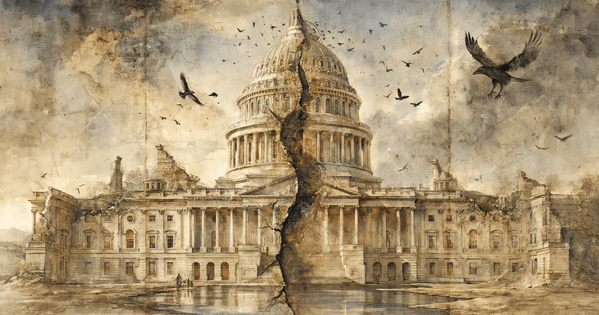
The Duverger Syndrome is democracies' most critical illness. Both the causes and the fixes are known. Solutions must be applied as a matter of priority.
The American democracy of the 21st century is the most advanced clinical case of the Duverger Syndrome on earth. Every one of the twelve symptoms is present, observable, and operating at full intensity. The terminal symptom — democracy itself as a partisan position — is no longer a forecast. It is a daily fact.
The standard explanation is that Donald Trump hijacked the Republican Party. The standard explanation is wrong. As Stuart Stevens — chief strategist for Mitt Romney's 2012 presidential campaign — put it: the hijacker is never popular on the plane. Trump has commanded 80–90% Republican approval throughout the Capitol attack of January 6, 2021, two impeachments, four criminal indictments, and a second term openly hostile to the constitutional order. Those are not hostage numbers. They are the numbers of a constituency getting exactly what it wanted.
Trump did not hijack the Republican Party. Single Choice Voting did, over fifty years. Trump revealed what the system had built.
The Republican Party of Lincoln, of Eisenhower, of even Reagan, was a different institution. The transformation from the party that signed the 1957 Civil Rights Act to the party of January 6 2021 was deliberate, and operated under the structural pressure of a binary voting system over five compounding phases.
Richard Nixon's Southern Strategy, designed by Kevin Phillips and Lee Atwater, was the deliberate trade of the party's Lincoln identity for white Southern racial resentment. Atwater himself, in a 1981 interview with political scientist Alexander Lamis, described the construction in his own words: by 1968 the explicit racial slurs had to be replaced with abstractions — "forced busing", "states' rights", tax cuts whose burden would fall hardest on Black families — but the political function was unchanged. This is not historical inference. It is the strategist's own account of the deliberate construction of racial coding in Republican politics. Reagan's 1980 campaign launch in Philadelphia, Mississippi — the town where three civil rights workers had been murdered in 1964 — extended the strategy. The party's coalition was being deliberately rebuilt on grievance.
Gerald Ford's pardon of Nixon established a principle that would compound for fifty years: senior Republicans operate above the law. The Iran-Contra affair confirmed it (Caspar Weinberger pardoned by George H. W. Bush before trial). The Iraq WMD affair confirmed it again — no consequences for fabricated intelligence that produced a devastating war. Each unpunished transgression made the next thinkable. Trump's eventual sense of personal impunity is the mature expression of a half-century pattern, not a personal innovation.
Newt Gingrich's Republican Revolution did not merely break norms — it codified their elimination as governing strategy. The 1990 GOPAC vocabulary memo distributed to Republican candidates across the country instructed them to use specific words about Democrats — pathetic, failure, sick, corrupt, criminal — and about Republicans — courage, opportunity, moral, strength. This was a systematic vocabulary of dehumanisation. Government shutdown became a weapon. Bipartisan cooperation became weakness. The opponent became not merely wrong but an enemy of civilisation.
Fox News did not merely report conservative opinion. It defined it in real time, day after day, telling Republican voters and legislators alike what a "real Republican" believed. This is not propaganda. It is identity infrastructure. The compliance machine the Gingrich Doctrine had named required an external reference point for daily enforcement. Fox supplied it. The legislative caucus complied. Studies showing that Republican opinion shifts measurably after extended periods without Fox access are measuring this norm-setting function — not persuasion, but identity entrenchment.
The Tea Party was the first visible mass expression of the base that Trump would inherit. The "birther" conspiracy against Barack Obama, the debt ceiling standoffs, the government shutdowns — all were practice runs for a politics that prioritised tribal purity over governance. The base was already present, mobilised, armed, and angry. Trump did not summon it. He found it.
By 2015, the door had been under construction for nearly half a century. The compliance machine had selected against the party's immune response. The racial coding had pre-prepared the base. The impunity precedent had pre-authorised norm violation. The Gingrich Doctrine had pre-named the enemy. Fox had pre-built the identity. The Tea Party had pre-mobilised the foot soldiers. Trump walked through.
The 2016 Republican primary fielded seventeen major candidates. The structural failure was visible in real time. The anti-Trump vote was split across Bush, Rubio, Cruz, Kasich, Christie, Carson, Paul, and a dozen others. Trump won early states with 25–35% of the vote — never a majority of his own party. He did not need one. The arithmetic of Single Choice Voting did the work for him.
This is the textbook Duverger's Law dynamic, reproduced inside a single party's primary. The unified faction (the MAGA base) wins. The divided faction (the establishment) loses. Establishment voters had nowhere to coordinate. Single-choice primaries do not allow score-based or approval-based aggregation. There was no instrument with which to register the genuine preference of the Republican electorate, which polled consistently against Trump as the field's eventual nominee.
Under Informed Score Voting, a 17-candidate field would have produced a different winner. Voters would have scored every candidate. The most-broadly-acceptable candidate would have won — not the candidate who concentrated a plurality of one faction. The 2016 Republican primary is not just the start of the Trump era. It is the canonical demonstration of why primaries under single-choice voting cannot filter out an unfit candidate when the field is crowded.
Two candidates with historically high unfavourability ratings entered the general election. Voters who disliked both — the so-called "double haters" — broke decisively for Trump. The structural failure was complete: with only two viable candidates, voter dissatisfaction with one becomes a vote for the other. There is no instrument with which to register "neither, please".
The 2024 rerun reproduced the dynamic, with an additional twist. Biden's age forced him to withdraw mid-cycle. Harris was nominated late, outside the usual primary process, with no time for the party to test her against alternatives. Trump's indictments did not disqualify him. Voters were left, once again, with a binary that forced a choice between two candidates contested by much of the country, albeit for different reasons. The lesser-of-two-evils mechanism is not an accident of any particular cycle. It is the mechanical output of the voting system, every time it is used.
The hijacker frame is consoling. It excuses Republican voters: they were manipulated. It excuses Republican legislators: they are complying under threat. It preserves the idea that the Republican Party is rescuable — that removing Trump restores what was there before. It is also false. The plane had three groups of people on it, not one.
The voting public — especially those who did not vote for Trump, or who voted for him on narrowly economic or anti-establishment grounds — are the closest thing to actual passengers. They booked a flight to a functioning democracy and found themselves somewhere else. Their choices were constrained by the binary: under single-choice voting, you pick one or you hand the election to the other side. Many voters horrified by the direction of the country found themselves with no structurally viable alternative. They are passengers in the most honest sense: present, largely powerless, not responsible for the route.
Trump is not the hijacker. He is more like the announced destination that turned out to be exactly what it said on the ticket. He told Republican voters, in explicit terms, what he intended to do: build the wall, lock up opponents, reward loyalty, punish disloyalty, reject democratic constraints on executive power. He was not hiding. The base heard him, understood him, and chose him — repeatedly, with increasing majorities. To call him a hijacker is to deny agency to the 80+ percent of Republicans who have supported him consistently across every test the constitutional order could throw at him.
This is the group the hijacker frame most systematically protects, and where the protection is most damaging. Elected Republican senators and representatives are not passengers. They are actors with agency, authority, votes, and the constitutional capacity to exercise them. They had gavels, committee chairmanships, the floor of the Senate, the power to convict at impeachment trial, the 25th Amendment. They had every option. They did not use them — or they used them minimally, performatively, in ways that registered their discomfort without producing consequences. They are not passengers who had the cockpit taken from them. They are crew members who handed over the controls. The correct word is accomplices.
Senator Mitch McConnell, on January 13, 2021, said on the Senate floor: "There is no question that President Trump is practically and morally responsible for provoking the events of the day." He then voted to acquit at the impeachment trial. He said Trump was guilty. He voted not guilty. That is not a hostage's behaviour. It is a calculation.
Senator Mitt Romney did not calculate. He voted to convict. He was censured by the Utah Republican Party. He announced he would not seek re-election. In his farewell Senate speech, he named precisely the failure of courage he had witnessed: his colleagues privately told him he was right, and then voted the other way. They knew, and they complied anyway. Dissent was possible. It was costly. The accomplices chose compliance.
The diagnosis is comprehensive or it is dismissable. Each of the twelve symptoms of the Duverger Syndrome is observable in 21st-century American politics, in mature form:
The pattern is not coincidental. It is causal. Each symptom is the predictable output of the same root mechanism — voters restricted to a single mark on a ballot, in a system where one side's gain is the other's loss. The symptoms reinforce each other. Each election cycle tightens the lock.
The most damaging long-term consequence of the Republican arc is not Trump. It is the Supreme Court he reshaped — and the institutional infrastructure that placed every justice on his short list before he ever held office.
The Federalist Society, founded in 1982, is a thirty-year project to reshape the American judiciary through systematic identification, training, networking, and placement of conservative legal talent. By the 2010s, every Republican administration had effectively delegated judicial nominations to the Society's leadership. The pipeline produced a pre-vetted bench of conservative judges ready to be slotted into any vacancy at any level of the federal judiciary.
In 2016, with eleven months remaining in Barack Obama's presidency, Senate Majority Leader Mitch McConnell refused to hold hearings on Merrick Garland's nomination to the Supreme Court — for 293 days — citing a self-invented "rule" about election-year nominations. The seat was held open until Trump could fill it. Four years later, with eight days remaining before the 2020 election, McConnell rushed Amy Coney Barrett's confirmation through. The same self-invented rule was abandoned the moment it became inconvenient.
The arithmetic of what followed is structural, not incidental. Three Trump-appointed justices — Neil Gorsuch, Brett Kavanaugh, Amy Coney Barrett — were nominated by a president who had lost the popular vote. They were confirmed by Senate majorities representing a minority of the American population. The 6–3 Supreme Court majority is detached from the country it adjudicates, and its detachment is not a bug. It is the deliberate output of a thirty-year capture project executed under the cover of Duverger Syndrome's binary, which made every judicial confirmation a tribal contest rather than a national one.
The fruits are visible. Dobbs v. Jackson (2022) overturned Roe. Trump v. United States (2024) granted broad presidential immunity for "official acts" — a doctrine engineered, as the timing makes plain, for the immediate benefit of the man who had nominated three of the justices delivering it. The Court has become the institutional projection of the binary's most extreme faction onto the entire polity.
This is the part that does not undo. Trump leaves office. The Court remains. The Federalist Pipeline produces the next generation. The damage is structural, generational, and visible in every constitutional case for the foreseeable future.
On January 6, 2021, a sitting president of the United States, having lost an election, directed a mob to the Capitol to stop the certification of his successor. The mob breached the building. Members of Congress fled. People died in the attack and its immediate aftermath. A gallows was erected outside for the Vice President of the United States, who had refused to participate in overturning the election.
For fourteen days, the country experienced something resembling a unified democratic immune response. Republican leaders condemned the attack. McConnell described Trump as "practically and morally responsible". House Minority Leader Kevin McCarthy said Trump "bears responsibility". The condemnations were public, recorded, and unambiguous.
Then they were reversed. McCarthy flew to Mar-a-Lago. The acquittal vote was calculated. The party realigned. The single most significant attack on the constitutional transfer of power since the Civil War became, in the space of two months, a partisan matter on which Republicans were expected to take Trump's side.
This is Symptom 12: democracy itself as wedge issue. When supporting elections you might lose becomes a "Democrat" position, the immune response is gone. The evidence is no longer hypothetical:
The implication is concrete. In the next election in which a Republican loses, the loss may not be conceded. This is no longer a forecast. It is observed pattern, ratified by the executive branch.
Other Duverger symptoms are damaging but recoverable. Symptom 12 is terminal. Once democracy becomes a partisan position, the structural cure must be applied before the next failure mode arrives.
The Duverger Syndrome explains the structural mechanics of how a binary system produces the symptoms catalogued above. But the United States in the 21st century also exhibits the parallel disease — the Tweed Syndrome — operating in tandem, and at full intensity. Where Duverger captures the voters, Tweed captures the institutions. Together, they account for the whole picture.
The Tweed Syndrome — named after William M. "Boss" Tweed, the 19th-century New York political operator whose machine perfected the conversion of public office into private patronage — is the family of pathologies arising from institutional capture, lobbying, dark money, the revolving door, and the systematic conversion of state machinery into private benefit. Wherever Duverger has tribally divided the country, Tweed quietly rearranges the institutions behind the binary's protective screen.
The two syndromes protect each other. Duverger's binary makes Tweed undetectable to half the country at any given time: each side's tribal loyalty makes its own side's corruption invisible while making the other side's corruption damning. Tweed in turn finances the Duverger machinery — donor money buys the primary radicalisation, the wedge-issue advertising, the legal infrastructure that maintains the binary. The cure for either syndrome alone is incomplete. Electoral reform without anti-corruption reform leaves the captured institutions in place. Anti-corruption reform without electoral reform leaves the binary that protects the capture.
This article will return to the dual diagnosis once the Pildem Framework's full Tweed Syndrome treatment is in place. For now, the territory is marked.
The diagnosis serves the prescription. The cure for the Duverger Syndrome is the replacement of Single Choice Voting with a method that lets voters express genuine preferences across the full range of candidates. Informed Score Voting is the answer.
What ISV would have changed:
The cure is structural. Better Republican leaders, operating within the same voting system, will face the same incentives. The compliance machine is a design output, not a character defect. Stuart Stevens' pessimism — "It's going to be a long time before we see a sane, centre-right party in America" — is correct under Single Choice Voting. ISV changes the calculation. Better candidates require better arithmetic. The arithmetic is the design choice.
The United States in the 21st century is what the Duverger Syndrome looks like at terminal expression. Other democracies are not exempt. They are earlier in the same disease.
The American experience is not exceptional. It is advanced. Other democracies that share the structural design will produce structurally similar outcomes — possibly later, possibly with different cultural surface — unless the underlying voting method is changed.
Trumpism is not an American disease. It is what happens to any democracy that runs Single Choice Voting through fifty years of binary realignment, a captured judiciary, a tribal media ecosystem, and an opponent willing to walk through every door the system has left open. The pathology is structural. The cure is structural.
It is not nature. It is design. And the design can be redrawn — before Symptom 12 becomes terminal everywhere.
The 2016 Republican primaries featured an initial field of seventeen major candidates — the largest of any party in modern American electoral history. Donald Trump won the nomination through a series of plurality wins in early states, never receiving a majority of Republican primary voters in the early phase.
On January 6, 2021, the United States Capitol was attacked by a mob of supporters of President Donald Trump in an attempt to disrupt the joint session of Congress assembled to count and certify the electoral votes that confirmed Joe Biden's victory in the 2020 presidential election.
The Federalist Society for Law and Public Policy Studies, most frequently called the Federalist Society, is an American conservative and libertarian legal organisation that has been highly influential in shaping the federal judiciary, particularly during Republican presidential administrations.
In American politics, the Southern strategy was a Republican Party electoral strategy to increase political support among white voters in the South by appealing to racism against African Americans. As the civil rights movement and dismantling of Jim Crow laws in the 1950s and 1960s visibly deepened existing racial tensions in much of the Southern United States, Republican politicians such as presidential candidates Richard Nixon and Ronald Reagan developed strategies that contributed to the political realignment of many white, conservative voters.