Right Speech replaces Freedom of Speech with a higher standard of democratic discourse. Not a restriction on expression, but an elevation of it — five principles designed into the architecture of platforms, institutions, and civic norms.
Published 1 April 2026
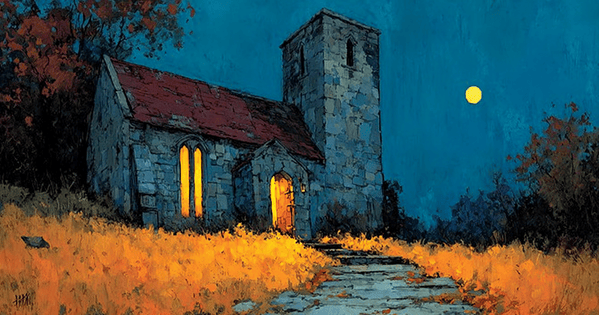
The chapel is quiet. The light is fading.
They come in ones and twos — some in professional dress, some in robes, some carrying nothing but the weight of what they have witnessed. A doctor who watched patients die of curable diseases because the lies were louder than the evidence. A journalist who wrote the truth and watched it sink beneath a tide of fabrication. A social worker who held the hands of families hiding from mobs that had been told to hate them. A teacher who tried to explain the difference between fact and opinion to children who had already learned, from the adults around them, that the difference does not matter.
And behind them, more quietly, figures in the vestments of traditions older than the thing they have come to bury — a monk, a rabbi, an imam, a pastor, a Hindu teacher, a Sikh elder. They have known for centuries what the world is only now discovering: that speech without ethics is not freedom. It is fire.
They take their seats. The officiant steps to the front. And the ceremony begins.
"Dear family and friends, we are gathered this evening to pay our last respects to Freedom of Speech — a concept that was, for a time, one of humanity's noblest aspirations. It sought to protect the voice of the powerless against the silence imposed by the powerful. It sought to create a space where truth could be spoken without fear. In its youth, it was magnificent."
"But we must be honest about what happened. Freedom of Speech did not die suddenly. It suffered a long and public illness, and those of us gathered here watched it deteriorate — some with grief, some with anger, some with the particular sadness of those who had tried everything and knew that nothing would be enough."
"Let me read, for the record, the causes that the coroner has noted in the report."
"Freedom of Speech confused the right to speak with the power to broadcast. When a person spoke to their neighbour, that was a right. When a machine amplified that speech to millions — selecting it not for its truth but for its capacity to provoke — that was something else entirely. Freedom of Speech made no distinction between the two. And so the megaphone was handed to the demagogue."
"It demanded to be the only right without limits. Every other right accepts boundaries. Property yields to taxation. Movement yields to borders. Privacy yields to due process. Only Freedom of Speech insisted on absolutism — and this absolutism became a ratchet that turned in only one direction. Every expansion became the new floor. Any qualification became tyranny."
"It was captured by its enemies. The loudest defenders of Freedom of Speech became those who used speech to destroy the conditions necessary for honest discourse. Hate drove the vulnerable from the public square. Disinformation drowned the truth. Propaganda dressed itself in the language of liberty. And Freedom of Speech could not tell the difference between its champions and its assassins — because it had never been designed to."
"It created a false choice: absolute freedom or censorship. Nothing in between was permitted. This binary — one of the most destructive ever manufactured — silenced every nuanced voice before it could speak. Anyone who attempted a third position was assigned to the wrong side and dismissed."
"And finally, its foundational promise was broken. Truth, we were told, would prevail in the open marketplace of ideas. But the marketplace was not a market. It was a casino. And the house — outrage, novelty, tribal allegiance — always won. The lies outran the truth. The careful were punished. The reckless were rewarded."
"These are the causes of death. They are not accusations — they are a coroner's report. Freedom of Speech did not choose to become what it became. But what it became is what it is. And we cannot, in good conscience, pretend otherwise."
"I now invite those who knew the deceased — those who lived under its regime, who believed in its promise, who suffered when it broke — to come forward and speak."
She rises slowly. She has the bearing of someone who has been standing for too long — in wards, in corridors, beside beds where the outcome was already decided. She does not look at the assembly. She looks at some point beyond them.
"I had the cures. We all had the cures. They were tested, they were proven, they were ready. And the lies were louder."
"I watched patients refuse treatment because someone with a screen and an audience had told them the treatment was poison. I watched families choose conspiracy over medicine, and then I watched those families grieve. I watched the bodies accumulate — not from the disease alone, but from the disinformation that wrapped itself around the disease like a second infection."
"When we asked for help — when we begged for the lies to be stopped, or at least slowed — we were told that this was the price of freedom. Freedom of Speech protected the liar and the healer equally. It could not tell the difference between a cure and a conspiracy theory. And so the conspiracy theories spread at the speed of light, while the cures moved at the speed of trust — trust that had already been destroyed."
"I do not blame Freedom of Speech for the disease. I blame it for refusing to distinguish between those who were trying to save lives and those who were, knowingly or not, ending them."
He stands with the careful posture of someone accustomed to being disbelieved. His notebook is in his pocket. He does not take it out.
"I spent thirty years doing what Freedom of Speech was supposed to make possible: investigating, verifying, publishing. I believed in it. I thought if I did my job well — if the story was solid, if the sources were confirmed, if the facts were unassailable — the truth would matter."
"It doesn't matter. Not anymore. Not in the way it was supposed to."
"I can spend six months on an investigation, verify every detail with three independent sources, publish it in a respected outlet — and by the time it reaches the public, it is already buried under a thousand fabrications that took six minutes to produce. The algorithm does not care what is true. It cares what is engaging. And lies are always more engaging than the truth, because lies are designed to be, and the truth is just the truth."
"Freedom of Speech gave me the right to publish. It also gave everyone else the right to drown me out. It made no distinction between the investigated and the invented, between the journalist and the troll farm. It protected my right to speak — and then it built a world where nobody could hear me."
She is younger than the others and carries herself with a kind of exhausted vigilance — the look of someone who is always listening for the next crisis. She grips the edge of the lectern when she speaks.
"I work with families. Real families — mothers, fathers, children. The kind of people who never appear in the debates about rights and principles, because they are too busy being afraid."
"I have held the hands of people who were hiding in their homes because a lie told on a stage turned their neighbours into threats. People who had lived in their communities for years, who worked, whose children went to local schools — reduced overnight to targets, because someone with power needed an enemy and they were convenient."
"When the mobs came — not with weapons, but with words, with threats, with bomb scares called into elementary schools — we were told that this was speech. Protected speech. That the lies about these families were opinions, and opinions are sacred."
"The children don't know about opinions. They know that they cannot go to school. They know that their parents are afraid. They know that something was said about them on television that made the world dangerous, and that nobody stopped it, because stopping it would have violated something called freedom."
"I buried Freedom of Speech a long time ago. I buried it the first night I drove a family to a shelter because their address had been posted online by someone exercising their rights."
He is grey-haired and soft-spoken, with the patience of someone who has explained the same thing a thousand times and knows he will explain it a thousand more.
"I teach young people how to think. Or I try to. It is harder now than it has ever been."
"I stand in front of a classroom and I say: here is a fact, supported by evidence. And a hand goes up, and a student says: that's just your opinion. Because they have been taught — not by me, but by the world Freedom of Speech built — that everything is opinion. That facts are a matter of perspective. That my thirty years of study carry the same weight as a video someone watched at breakfast."
"Freedom of Speech promised a marketplace of ideas. What it delivered was a marketplace of noise, where the loudest voice wins regardless of what it is saying. It taught an entire generation that all claims are equal — that the scientist and the conspiracy theorist deserve the same platform, the same respect, the same attention. And now I face the consequences of that lesson every day, in the eyes of young people who have lost the ability to tell the difference between knowledge and performance."
"I do not mourn Freedom of Speech. I mourn what it did to the meaning of truth."
The officiant pauses. He turns toward the figures seated together at the side of the chapel — the robed, the turbaned, the simply dressed. "We have heard from those who lived under Freedom of Speech and suffered its failures. Now let us hear from those whose traditions tried to warn us — centuries before we needed the warning."
He rises without hurry. His robes are plain. He speaks as if he has all the time in the world — which, in a certain sense, he does.
"Twenty-five centuries ago, the Buddha named this. He called it Sammā vācā (सम्मा वाचा) — Right Speech. He placed it on the Eightfold Path alongside right action, right livelihood, right understanding. Not because speech is a small thing, but because it is as consequential as any act."
"He taught four abstentions: from falsehood, from divisive speech, from harsh speech, from idle chatter. He did not teach silence. He taught discernment — the wisdom to know when speech serves understanding and when it serves only the ego's need to be heard."
"Freedom of Speech asked only one question: may I speak? The Buddha asked four: Is it true? Is it kind? Is it beneficial? Is it the right time? One question was never enough. It was never going to be enough."
She adjusts her tallit and speaks with the precise cadence of someone trained in argument — in the kind of argument that seeks truth, not victory.
"In our tradition, we have a concept called lashon hara (לשון הרע) — the evil tongue. It means speaking ill of someone, even if what you say is true. Even truth can be a weapon. Even truth can destroy."
"We also have machloket l'shem shamayim (מחלוקת לשם שמיים) — disagreement for the sake of heaven. The Talmud preserves minority opinions alongside majority rulings, because the sages understood that genuine disagreement is sacred. It is how we approach truth: not by silencing the dissenter, but by honouring the dissent that aims at understanding."
"Freedom of Speech could not tell the difference between disagreement for the sake of heaven and disagreement for the sake of destruction. It gave the same protection to the seeker of truth and to the merchant of hate. Our tradition has known for three thousand years that this distinction matters. It is the distinction that keeps a society from tearing itself apart."
He stands with his hands folded, composed, and recites first in Arabic before translating — giving the words their original weight.
"The Quran commands: O you who believe, if a sinful person brings you any news, verify it, lest you harm people in ignorance and then become regretful. This was revealed fourteen centuries ago. Verify before you speak. Verify before you share. Verify before you act on what you have heard."
"Our tradition also says: Man kāna yu'minu billāhi wal-yawmil-ākhir, fal-yaqul khayran aw liyaṣmut (من كان يؤمن بالله واليوم الآخر فليقل خيرًا أو ليصمت) — Whoever believes in God and the Last Day, let him speak good or remain silent. Not every thought deserves a voice. Not every voice deserves an audience. This is not censorship — it is discernment. It is the recognition that speech is a trust, and a trust carries responsibilities."
"Freedom of Speech removed the responsibility and kept only the right. It told people they could say anything, to anyone, at any volume, without consequence. Our tradition has always known that speech without responsibility is not freedom — it is recklessness. And recklessness, in speech as in all things, leaves wreckage behind it."
She speaks softly, but with the particular authority of someone who has spent a lifetime comforting the grieving — and who now finds herself among them.
"The Epistle of James warns us: the tongue is a small member, yet it boasts of great things. See how great a forest is set ablaze by such a small fire. A small fire. That is what we were told to watch for. Not the grand conflagration — the spark. The careless word. The idle rumour. The lie told so casually that the teller does not even recognise it as a lie."
"And our Lord said: Sit autem sermo vester: est, est; non, non — Let your yes be yes, and your no be no. Speak plainly. Speak honestly. Do not hide behind cleverness or ambiguity. Say what you mean. Mean what you say. Stand behind it."
"Freedom of Speech protected the spark and the forest fire equally. It could not see that the tongue that sets the forest ablaze is not exercising a right — it is committing an act of destruction. We were warned. We did not listen."
He is elderly, with the calm of someone who measures time in longer units than most. He speaks slowly, weighing each word as if it were itself an offering.
"In our tradition, we hold two principles in balance: satya (सत्य) — truthfulness — and ahimsa (अहिंसा) — non-harm. The ancient teaching says: Satyam brūyāt, priyam brūyāt (सत्यं ब्रूयात् प्रियं ब्रूयात्) — Speak the truth. Speak what is pleasant. But do not speak an unpleasant truth for the purpose of causing pain, and do not speak a pleasant untruth for the purpose of giving comfort."
"This balance is everything. Truth without compassion is cruelty. Compassion without truth is deception. Speech must hold both — must be honest and kind at once, must serve understanding without inflicting unnecessary suffering."
"Freedom of Speech valued only one half of this balance. It protected truth — and also falsehood. It protected kindness — and also cruelty. It refused to ask whether speech was serving understanding or serving harm, because asking that question felt like a violation of its own principle. And so it stood by, neutral, while the balance was destroyed."
He stands tall, his turban white, his bearing that of someone for whom faith is not a matter of belief but of daily practice. He speaks with warmth.
"Guru Nanak taught us: Sach hū orai sabh ko, upar sach āchār (ਸਚਹੁ ਓਰੈ ਸਭੁ ਕੋ ਉਪਰਿ ਸਚੁ ਆਚਾਰੁ) — Truthful living is higher than truth. This means that it is not enough to speak truly — you must also live truly. Your words and your actions must be one. A person who speaks of justice and practises injustice has not spoken at all — they have only made noise."
"Our tradition names five thieves of the soul: lust, anger, greed, attachment, and pride. Three of these — anger, greed, and pride — are the corruption of speech at its source. When a person speaks from anger, from greed, from pride, the words are already poisoned before they leave the mouth. No amount of freedom can purify speech that arises from a corrupted heart."
"Freedom of Speech asked nothing about the heart of the speaker. It asked only whether the state had interfered. But the state was never the only danger. The danger was also within — within the speaker, within the system, within the design of a world that rewarded the loudest voice regardless of what it carried."
The eulogies are finished. The chapel falls silent.
The officiant steps forward and makes a gesture — not of closure, but of transition. The assembly rises. They move together, slowly, out of the chapel and into the evening air, where the last light is turning the sky the colour of an old bruise — purple and gold and fading.
They carry no coffin. Freedom of Speech was not a body. It was an idea, and ideas do not have bones. What they carry instead is something heavier: the knowledge that a concept they were raised to revere — that many of them built their careers and their convictions upon — has failed. Not because it was attacked from outside, but because it was hollow at the centre. It could not distinguish between its own purpose and its own destruction.
The procession moves through a garden. There is no grave. There is instead a clearing, and in the clearing, a simple stone. The officiant speaks:
"Here we lay to rest the construct known as Freedom of Speech. We honour what it tried to be: the shield of conscience, the protector of dissent, the voice of the voiceless against the powerful. We acknowledge what it became: a shield for liars, a weapon for demagogues, a design flaw in the architecture of democracy."
"We release it. Not with contempt, but with the sorrow of letting go of something that was once great and is now broken beyond repair."
He pauses. The assembly waits.
"But we do not leave this place empty-handed. Because what was noblest in Freedom of Speech — the protection of conscience, the defence of dissent, the insistence that truth must be spoken even when power forbids it — these things did not die. They were never the property of Freedom of Speech. They are older than any constitution. They belong to humanity itself."
There is a figure standing at the edge of the clearing. It has been there all along — present but unobtrusive, listening to every eulogy, bearing witness to every grief. It steps forward now, not with triumph, but with the solemnity of someone accepting an inheritance they did not seek and cannot refuse.
The officiant turns to the assembly.
"What Freedom of Speech tried to be — and what it could not, in the end, sustain — does not disappear tonight. It is reborn. Reincarnated in a form that is older than the thing we are burying, and worthier of the spirit it carries."
"Right Speech does not ask only whether you may speak. It asks whether your speech is offered in good faith. Whether you stand behind your words. Whether you respect the boundary between truth and falsehood. Whether the volume of your voice is earned or merely engineered. Whether you are open to being wrong."
"These are not restrictions. They are the qualities that make speech worth protecting in the first place. They are what Freedom of Speech was supposed to cultivate and never did — because it never asked. It only permitted. Permission without cultivation is a garden without a gardener: the weeds will always win."
"Right Speech is the gardener."
The figure steps forward. She places a hand on the stone — a gesture of respect to what came before — and then turns to face the assembly. When she speaks, her voice is quiet, but it carries. It is not a prayer. It is a vow.
Make me an instrument of your peace:
where there is hatred, let me sow understanding;
where there is falsehood, truth;
where there is noise, discernment;
where there is despair, hope;
where there is darkness, light;
where there is division, dialogue.Grant that I may not so much seek
to be heard as to listen,
to be right as to understand,
to be amplified as to illuminate.For it is in listening that we are heard,
it is in correcting ourselves that we earn correction,
and it is in the dying of the old word that the new word is born.
The assembly is still. No one speaks. The vow hangs in the evening air like the last note of a hymn — not fading, but settling into the ground, into the stone, into the silence between them.
Then the officiant speaks, one last time.
"Every tradition represented here tonight has known this for centuries. The Buddhist who taught discernment. The rabbi who distinguished disagreement for the sake of heaven from disagreement for the sake of destruction. The imam who commanded verification before speech. The pastor who warned about the tongue that sets the forest ablaze. The Hindu teacher who held truth and compassion in balance. The Sikh elder who taught that truthful living is higher than truth."
"They were not arguing against freedom. They were arguing for something higher than freedom: responsibility. Wisdom. The understanding that the right to speak is sacred precisely because speech has consequences — and that sacredness demands care, not carelessness."
The officiant's voice drops. The evening is nearly dark now.
"Freedom of Speech asked one question: may I speak? Right Speech asks five: Am I speaking in good faith? Am I accountable for my words? Am I respecting the truth? Is the amplification proportionate? Am I willing to be corrected?"
"One question was not enough. It was never going to be enough."
The stone stands in the clearing. The figure of Right Speech stands beside it. The assembly is still. And then, one by one, they begin to leave — not grieving, but carrying something new. Not a right, but a responsibility. Not a permission, but a practice. Not a freedom from, but a freedom toward.
The torch has been passed.
May Freedom of Speech rest in peace.
May Right Speech rise.